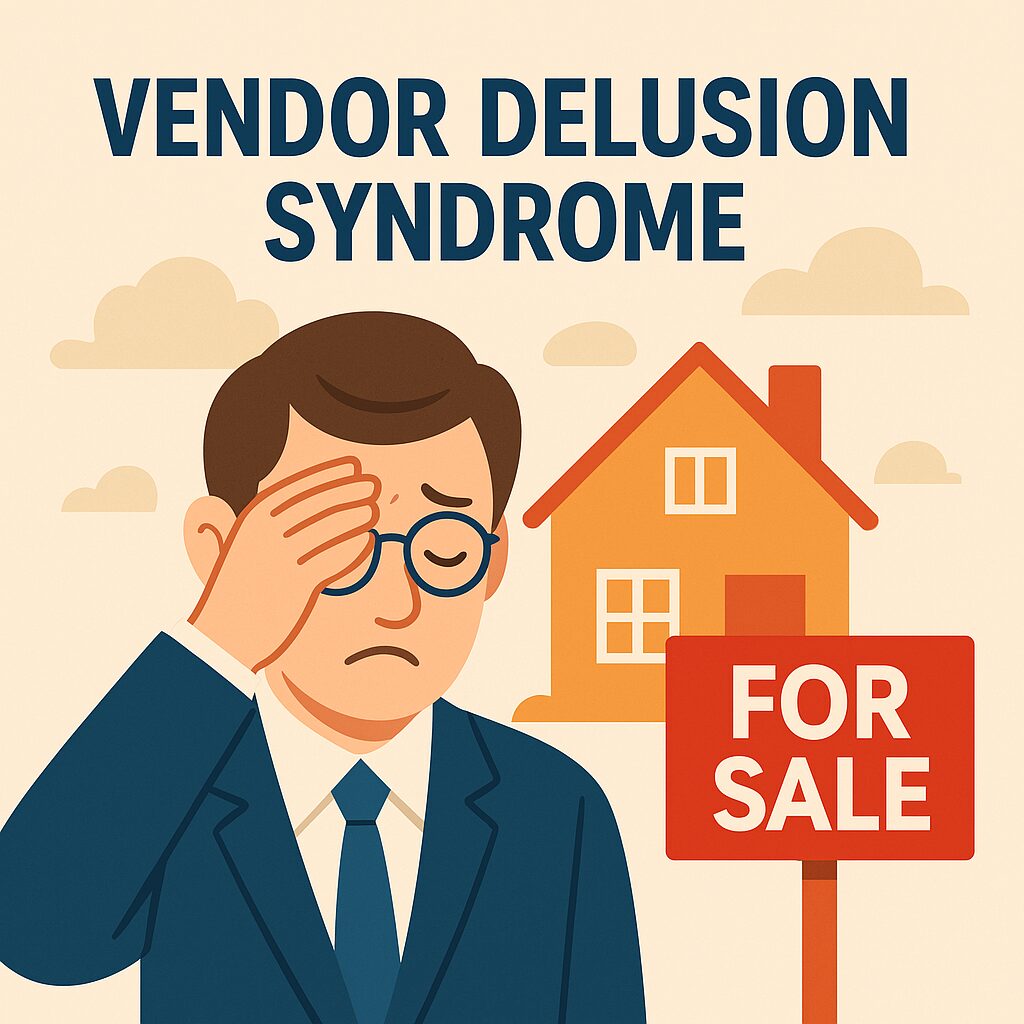
It is a well-known fact that property value is largely determined by supply, demand, location, and—most importantly—the ability of the vendor to separate sentiment from reality. However, a significant portion of home sellers seem to suffer from a condition that might best be described as Vendor Delusion Syndrome (VDS). VDS is marked by the afflicted individual’s belief that their property is worth far more than any sane person (or appraiser) could justify. Common symptoms include stubborn refusal to lower asking prices, exaggerated emotional attachment to outdated wallpaper, and an obsessive comparison to properties that only exist in their minds.
The Price Point Paradox: The most glaring symptom of VDS is the Vendor’s insistence that their property is worth 20% more than any other house in the neighborhood—despite the house next door having sold last month for 25% less. This is often justified by vague statements such as, “But it has potential,” or “It’s just waiting for the right buyer.”
Sentimental Overvaluation: Afflicted individuals frequently ascribe exorbitant value to specific elements of their home, including that “gorgeous” avocado green kitchen or the bathroom tiles that were once “a modern marvel in the 70s.” As if those design choices would hold the same appeal to today’s buyers as they did to the sellers in their prime.
The “Comparable Property” Confusion: Perhaps the most classic symptom of VDS is the Vendor’s relentless search for comparables (or “comps”). However, these are rarely based on reality. A true VDS sufferer may present the house down the street as a “direct comparison,” despite significant differences in square footage, location, and the fact that it was once the site of a historic potato famine. This phenomenon is often referred to as the “it’s just like that house on Elm Street, only better” delusion.
The diagnosis of VDS can be made in the field by any estate agent who has encountered a vendor insisting their 2-bedroom flat overlooking a busy motorway is worth as much as a country estate with panoramic views. Confirmation is generally achieved after a simple conversation where the vendor, under no circumstances, will entertain a suggestion to adjust their expectations to market realities. Should this conversation result in the vendor proclaiming, “I’ve spoken to a few people, and they think it’s worth much more,” the condition is confirmed.
The treatment for Vendor Delusion Syndrome (VDS) typically requires a combination of reality therapy and humor. Agents should proceed with caution, as too much reality may cause symptoms of shock, such as “But I’ve invested so much into it!” or “I can’t possibly go below this price—my neighbor sold for more!”
Educational Intervention: Agents should gently educate the vendor on the principles of the housing market—namely, that buyers are not interested in what the property “could” be or “was” in its prime, but rather in what it is right now. Comparables, not feelings, are king.
Reality Check (A.k.a. “The Price Reduction Party”): A skilled agent can help gently steer a vendor into accepting a price reduction by offering tangible evidence of market trends. The conversation might begin with, “Let’s take a look at the price per square foot of this lovely home here… oh, and the one next door! Isn’t it fascinating how they both sold so quickly?”
Humorous Reframing: Finally, a bit of humor can often diffuse the tension. Suggesting that a property’s worth is not determined by its owner’s enthusiasm for a garden gnome collection can be an effective and light-hearted method of dealing with denial.
Vendor Delusion Syndrome is a real and challenging condition faced by many real estate professionals, though its symptoms are often treatable with the right mix of patience, education, and humor. While the journey to recovery for the vendor may be long and winding, with regular doses of market data and gentle encouragement, there is always hope that one day, the vendor will learn to see their property for what it truly is—a charming, if slightly over-ambitious, slice of the housing market.
Further Reading:
“When Asking Price Meets Reality: The Art of Real Estate Negotiation”
“In It for the Long Haul: How to Endure the Vendor Who Won’t Budge”
“From Denial to Acceptance: A Guide to Pricing Your Home Correctly”
In conclusion, while VDS may be widespread, it’s important to remember that with the right approach, even the most delusional of vendors can come to terms with reality—just maybe not today.